
Why Adults Need Relaxing Hobbies (And Why Screen Time Isn’t Cutting It)
You get home from work, drop your bag, sit on the couch, and reach for your phone. Twenty minutes becomes an hour. You watched videos, checked messages, scrolled through social media—and somehow you don’t feel particularly rested.
Sound familiar?
For many adults, “relaxing” has become synonymous with consuming more content. But there is a difference between being distracted and actually unwinding.
A relaxing hobby gives your brain something different to do. Instead of reacting to notifications, deadlines, and endless information, you get to make, move, notice, learn, or connect. The best hobbies for stress relief don’t need to be productive. In fact, part of their value is that they give you permission to do something simply because you enjoy it.
Whether you have 20 minutes after work or a free Saturday afternoon, there are plenty of relaxing hobbies for adults that can help you slow down—and some can even help you meet people in the process.
The Mental Health Benefits of Having a Hobby
A hobby can provide a welcome break from the demands of work and everyday responsibilities. Creative activities can encourage focus and absorption, while movement-based hobbies can help you reconnect with your body.
There is also value in having something to look forward to. A weekly pottery class, gardening session, painting night, or walking group can create a small but meaningful rhythm outside your normal routine.
Hobbies aren’t a substitute for professional mental health care, and they won’t make stress disappear. But they can become a practical part of a broader self-care routine.
What Makes a Hobby “Relaxing” vs. Just Another Task?
Not every enjoyable activity is automatically relaxing.
A hobby tends to feel restorative when it gives you some combination of:
- Low pressure: You aren’t being graded or measured.
- Focused attention: You can become absorbed in what you’re doing.
- Sensory engagement: You are working with your hands, body, surroundings, or senses.
- Choice: You get to decide how and when you participate.
- Enjoyment: The activity feels worthwhile even when there is no practical outcome.
- Connection: When you want it to, the hobby can bring you into contact with other people.
The goal isn’t to find the “perfect” hobby. It’s to find something that makes your shoulders drop a little.
If you’re looking for an activity that helps you slow down while giving you space to express yourself, explore our guide to Creative Hobbies for Adults for more ideas, from painting and pottery to journaling and hands-on crafts.
How to Choose the Right Relaxing Hobby for You
The best relaxing hobby is the one you’ll actually want to return to.
Before buying supplies or signing up for six months of classes, think about what your life is currently missing.
Quick Self-Check: Do You Want Solo or Social Relaxation?
Ask yourself:
Do I need quiet?
Try journaling, reading, gardening, drawing, puzzles, knitting, or nature walks.
Do I need creative expression?
Try painting, pottery, photography, flower arranging, candle making, or art journaling.
Do I need movement?
Try yoga, walking, dancing, swimming, or gentle cycling.
Do I need a connection?
Try a paint & sip, community garden, book club, pottery class, craft workshop, or walking group.
Do I need a break from screens?
Choose something tactile and offline, such as ceramics, gardening, cooking, knitting, or painting.
Your stress trigger can be a useful guide. If your job leaves you mentally overloaded, a hands-on hobby may be especially satisfying. If you spend all day sitting, movement might be more restorative. If you work from home and rarely see people, a social hobby can provide a much-needed connection.
Budget and Time Considerations
You don’t need a huge budget or an empty calendar.
Some of the best relaxing hobbies are inexpensive or free:
- Walking
- Journaling
- Drawing
- Reading
- Gardening from cuttings or seeds
- Meditation
- Photography with your phone
- Birdwatching
- Stretching
- Cooking
If you’re busy, start with a hobby that fits into the life you already have. A 20-minute sketching session after dinner is more sustainable than an elaborate weekend project you never have time to begin.
10 Relaxing Creative Hobbies for Adults
Creative hobbies are particularly appealing when your daily life is dominated by emails, spreadsheets, meetings, and screens. They give your attention somewhere tangible to go.
1. Painting and Paint & Sip Nights
Painting doesn’t require artistic talent. You can follow a guided canvas, experiment with abstract shapes, or simply play with color.
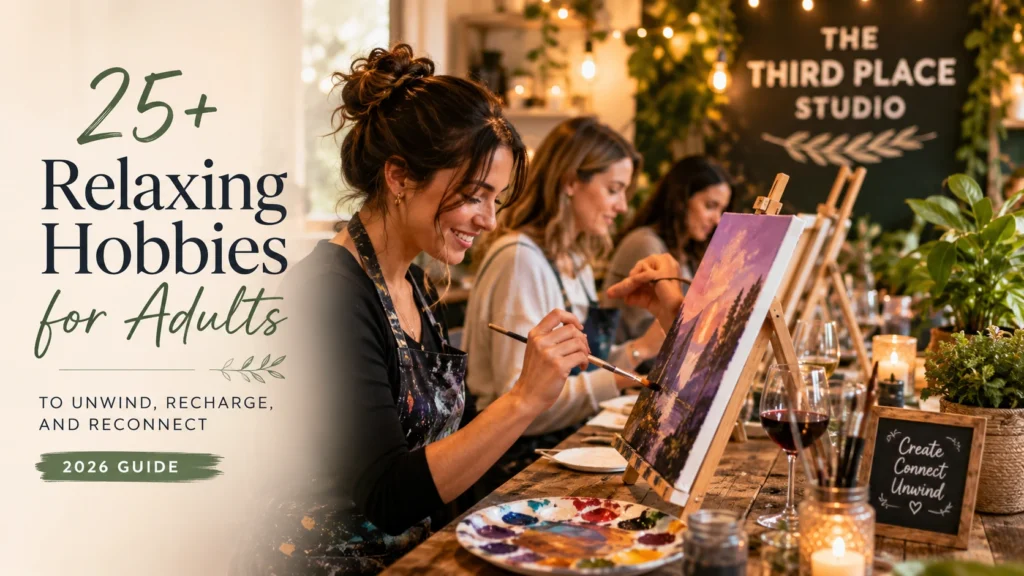
Paint & sip events add a social element, making them a great option if you want to relax without spending the evening alone. There’s something uniquely enjoyable about creating alongside people who are also there simply to have a good time.
A guided class can also remove the pressure of figuring out what to paint.
Best for: creativity, social relaxation, beginners, screen-free evenings.
2. Pottery and Ceramics
Working with clay is wonderfully tactile. Kneading, shaping, smoothing, and decorating clay can give your hands something to focus on while your mind gets a break.
Pottery classes also offer a natural social environment. You’re working on your own project, but you’re surrounded by other people doing the same thing—an easy form of community without the pressure to constantly make conversation.
Best for: hands-on creativity, focus, social connection.
3. Journaling and Art Journaling
Traditional journaling can help you put thoughts into words, while art journaling combines writing with color, collage, doodles, and mixed media.
You don’t need an elaborate notebook. Five minutes and a blank page are enough.
Try prompts such as:
- What felt good today?
- What am I carrying that I can put down?
- What do I want more of this week?
- What is something small I’m looking forward to?
Best for: reflection, quiet evenings, self-expression.
4. Candle Making
Candle making combines creativity with sensory enjoyment. Choosing scents, colors, containers, and designs turns the process itself into the hobby—not just the finished candle.
It’s also a satisfying project for people who enjoy making something tangible they can use later.
Best for: creative projects, sensory relaxation, DIY lovers.
5. Flower Arranging
Flower arranging gives you a reason to slow down and pay attention to color, texture, shape, and composition.
You don’t need a formal class. Pick up a few seasonal flowers and experiment with different arrangements at home. A workshop can make the experience more social and provide guidance for beginners.
Best for: creativity, nature lovers, mindful attention.
6. Knitting or Crocheting
Repetitive hand movements can make knitting and crocheting feel calming, particularly once you’ve learned the basics.
They’re also portable. A small project can come with you while you’re traveling, waiting for an appointment, or enjoying a quiet evening.
Best for: repetitive, screen-free relaxation.
7. Drawing
Drawing is one of the easiest creative hobbies to start. Grab a pencil and paper and draw objects around you, try simple patterns, or follow beginner tutorials.
Don’t make “being good at drawing” the goal. Let observation and experimentation be the point.
Best for: quiet focus, beginners, low-cost creativity.
8. Photography
Photography can turn an ordinary walk into an opportunity to notice your surroundings.
Try a simple challenge: photograph five interesting textures, three unusual colors, or one beautiful detail you normally overlook.
Best for: mindfulness, outdoor time, creativity.
9. Cooking and Baking
Cooking can be stressful when it’s another item on your to-do list—but it can also become a relaxing creative ritual when you give yourself permission to experiment.
Try making homemade pasta, baking bread, decorating cookies, or learning one new cuisine.
Best for: sensory engagement, creativity, people who enjoy practical hobbies.
10. Puzzles and Adult Coloring
Puzzles and coloring books offer structured concentration without requiring a major creative leap.
They’re particularly useful when you want something to do with your hands while stepping away from work or social media.
Best for: quiet evenings, focus, screen-free downtime.
8 Relaxing Hobbies for Nature Lovers
Nature-based hobbies can be especially appealing when your day happens mostly indoors.
11. Plant Care and Houseplant Workshops
Caring for plants gives you a small, ongoing ritual. Watering, pruning, repotting, and watching new growth can make your home feel more alive.
If you’re unsure where to start, a plant workshop can take away the guesswork while giving you a chance to meet other plant lovers.
Best for: nurturing routines, creativity, homebodies.
12. Gardening
A garden doesn’t have to mean a large backyard. Herbs on a windowsill, vegetables in containers, or flowers on a balcony all count.
Gardening encourages you to work according to a slower rhythm: plant, water, wait, observe.
Best for: outdoor time, hands-on activity, patience.
13. Nature Walks and Forest Bathing
You don’t have to turn a walk into a workout.
Leave your headphones at home occasionally and pay attention to birds, trees, sunlight, textures, and sounds. The Japanese practice often translated as “forest bathing” emphasizes spending intentional time among trees and nature.
Best for: getting outdoors, slowing down, sensory awareness.
14. Birdwatching
Birdwatching transforms a walk into a treasure hunt.
You can start with nothing more than curiosity and your surroundings. A basic field guide or bird-identification app can help you learn as you go.
Best for: patience, outdoor mindfulness, curious minds.
15. Nature Photography
Combine photography with outdoor exploration by looking specifically for interesting plants, landscapes, insects, architecture, or seasonal details.
The objective isn’t to create professional images. It’s to give yourself a reason to look more closely.
Best for: creativity and outdoor relaxation.
16. Herb Growing
Growing basil, mint, rosemary, coriander, or other herbs can be surprisingly satisfying—even in a small kitchen.
You’ll have a simple routine to care for and something useful at the end.
Best for: beginners, small spaces, practical hobbies.
17. Flower Gardening
Flower gardening adds color and seasonal change to your surroundings.
Choose low-maintenance varieties if you’re new to gardening and focus on enjoying the process rather than creating a perfect garden.
Best for: nature lovers, visual creativity, outdoor time.
18. Outdoor Sketching
Take a notebook outside and sketch whatever catches your attention.
Trees, buildings, flowers, people, clouds, and everyday objects all make good subjects. The practice encourages you to observe instead of rush.
Best for: creative people who want a slower outdoor hobby.
7 Relaxing Wellness-Based Hobbies
Wellness hobbies can help you shift your attention from constant doing toward being present.
19. Yoga and Gentle Movement
Yoga can combine movement, breathing, and focused attention.
You don’t need to pursue advanced poses. A gentle beginner class, stretching routine, or restorative yoga session may be enough to create a transition between a busy day and a quieter evening.
Best for: desk workers, physical tension, mindful movement.
20. Meditation
Meditation can be as simple as sitting quietly and paying attention to your breathing.
If traditional meditation feels intimidating, start with five minutes. Guided meditation can also make beginning easier.
Best for: people who want a quiet, low-cost practice.
21. Sound Baths
Sound baths use instruments such as singing bowls, gongs, and other resonant instruments to create an immersive listening experience.
For many people, the appeal is simply having a dedicated period when they don’t need to produce, respond, or accomplish anything.
Best for: deep relaxation, sensory experiences, people who enjoy guided wellness activities.
22. Breathwork Practices
Breathwork involves intentionally changing or observing your breathing patterns.
For beginners, gentle breathing exercises can be a simple way to create a pause during a busy day. If you have a medical condition or become uncomfortable while practicing, seek guidance from an appropriate healthcare professional.
Best for: short breaks, transitions, mindful pauses.
23. Tai Chi
Tai chi combines slow, deliberate movement with focused attention.
Its gentle pace can make it appealing if high-intensity exercise feels more like another obligation than relaxation.
Best for: gentle movement, balance, mindful practice.
24. Swimming
Swimming can provide a change of environment, rhythmic movement, and a break from screens.
For a relaxing approach, focus less on speed and more on steady movement and enjoying the water.
Best for: people who like movement but want something meditative.
25. Walking
Never underestimate the humble walk.
A 20-minute walk around your neighborhood can become a genuine hobby when you make it intentional. Explore different routes, listen to the sounds around you, photograph interesting details, or walk with a friend.
Best for: almost anyone, especially people who spend long hours at a desk.
Solo vs. Social: Relaxing Hobbies You Can Do With Others
Relaxation doesn’t always mean being alone.
Sometimes the thing you need most after a stressful week isn’t silence—it’s being around people without having to perform.
That’s where social hobbies can be especially powerful.
Why Community-Based Hobbies Boost Relaxation Even More
A community hobby combines the restorative qualities of an activity with the potential benefits of social connection.
Think about the difference between watching a video of someone painting and sitting at a table with six other people, brushes in hand, chatting about your week while you create something.
The second experience gives you opportunities for conversation, laughter, shared attention, and belonging.
That’s one reason classes and workshops can be such useful “third places”—spaces outside home and work where people can regularly gather.
Good social hobbies for adults include:
- Paint & sip nights
- Pottery classes
- Plant workshops
- Book clubs
- Community gardening
- Walking groups
- Craft circles
- Cooking classes
- Dance classes
- Photography groups
- Volunteer activities
- Wellness workshops
Finding a “Third Place” Outside Home and Work
Home is where you rest. Work is where you contribute. A third place is somewhere else you can spend time, interact with people, and feel part of a community.
A hobby can help you create that space naturally.
You don’t necessarily need to arrive knowing anyone. A recurring class or workshop gives you a reason to return, familiar faces to recognize, and an activity that makes conversation easier.
For adults who feel isolated, work remotely, have recently moved, or simply want more connection in everyday life, that can be just as valuable as the hobby itself.
How to Actually Stick With a New Relaxing Hobby
Finding a hobby is easy. Making it part of your life is harder.
The trick is to reduce friction.
Start Small: The 20-Minute Rule
Don’t wait for an entire free afternoon.
Give yourself 20 minutes.
Paint for 20 minutes. Walk for 20 minutes. Journal for 20 minutes. Repot one plant. Read a chapter. Practice a few yoga poses.
If you enjoy it, you can continue. If you don’t, you’ve only invested a small amount of time.
Consistency matters more than intensity.
Make It Social for Built-In Accountability
If you struggle to make time for yourself, put the hobby on your calendar.
Better yet, make it a commitment involving other people.
A weekly pottery class or monthly paint night gives the activity a place in your schedule. You don’t have to rely on motivation every time.
And when other people are expecting you, you’re more likely to leave work, put down your phone, and actually go.
Frequently Asked Questions About Relaxing Hobbies for Adults
What is the most relaxing hobby for adults?
There isn’t one universally most relaxing hobby. The right choice depends on what you find restorative. Painting, gardening, walking, journaling, pottery, yoga, and meditation can all be relaxing; for some people, a social hobby is more restorative than a solitary one.
What hobbies help with anxiety and stress?
Gentle movement, creative activities, time in nature, mindfulness practices, and enjoyable social activities can all be useful parts of a stress-management routine. If anxiety is persistent or interfering with daily life, a hobby should complement—not replace—professional support.
What are cheap or free relaxing hobbies?
Walking, journaling, drawing, reading, stretching, meditation, photography with your phone, birdwatching, and gardening from cuttings can all be started inexpensively. You don’t need expensive equipment to create meaningful downtime.
How do I find time for a hobby as a busy adult?
Start with a small commitment rather than waiting for a large block of free time. Try 15–20 minutes a few times a week, schedule it like any other appointment, and choose a hobby that is easy to start and stop.
Is it better to have a hobby alone or with other people?
Neither is inherently better. Solo hobbies can give you quiet and independence, while social hobbies add connection and accountability. Many adults benefit from having both—a quiet hobby for recharging and a social hobby for community.
What hobbies are good for people who sit at a desk all day?
Walking, yoga, swimming, gardening, dancing, tai chi, and other gentle movement-based hobbies can provide a physical change from sitting. Creative hands-on hobbies such as pottery or painting can also provide a welcome break from screens.
How long does it take for a new hobby to reduce stress?
There is no universal timeline. You may notice an immediate sense of enjoyment or mental separation from work, while the broader benefits of establishing a regular hobby can take longer. Focus on finding an activity you genuinely enjoy rather than treating relaxation as another performance goal.
Key Takeaways
- Relaxing hobbies for adults don’t need to be productive. Their value can simply be that they give you time to enjoy something.
- Match the hobby to your stress trigger. If you’re mentally overloaded, try a hands-on creative activity. If you’re physically stagnant, try gentle movement. If you’re socially disconnected, try a group hobby.
- Creative hobbies can provide an engaging alternative to passive screen time. Painting, pottery, drawing, journaling, and crafts all give your attention something tangible to focus on.
- Nature-based hobbies can help you slow down. Gardening, plant care, walking, birdwatching, and outdoor photography encourage you to spend time away from your usual environment.
- Social hobbies offer more than an activity. Classes and workshops can become regular spaces for conversation, familiarity, and community.
- You don’t need hours of free time. Start with 15–20 minutes and build from there.
- The best hobby is one you’ll actually enjoy returning to. Choose curiosity over perfection and consistency over productivity.
Most importantly, don’t turn relaxation into another item on your productivity checklist.
You don’t need to become an expert. You don’t need to monetize your hobby. You don’t need to produce something impressive.
You just need something that gives you a reason to put the phone down, step away from work, and be present for a while.
And sometimes, the easiest way to start is to do that alongside other people.
If painting sounds like your kind of reset, consider joining a relaxed, beginner-friendly paint & sip or creative workshop at The Third Place Studio. You can show up without needing to know anyone, try something new, and spend a few hours creating good company.