
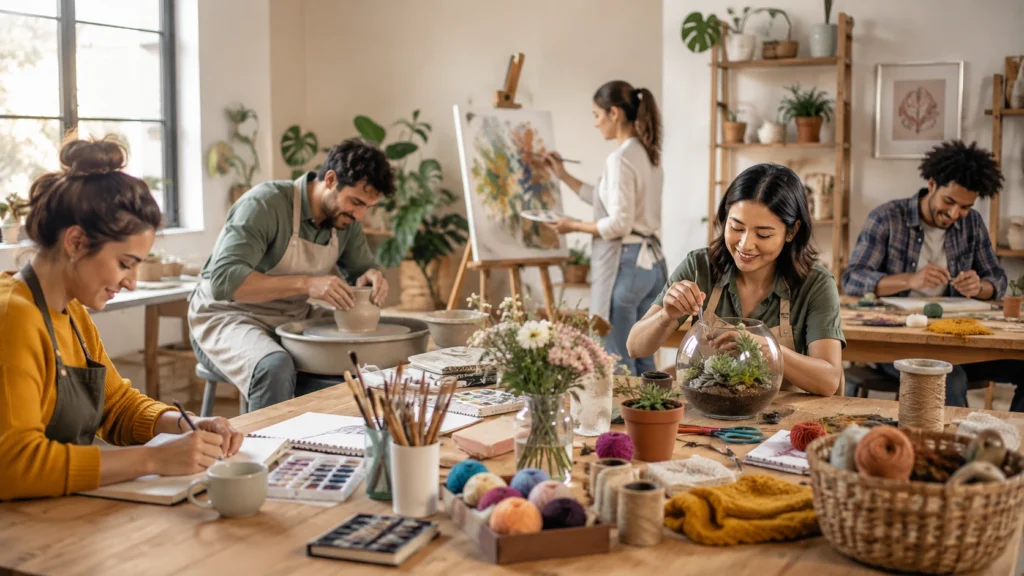
There’s a specific kind of exhaustion that comes from finishing work, closing the laptop, and then… scrolling. Not because you want to, but because you can’t think of what else to do with your hands, your evening, or your brain. If that sounds familiar, you’re not alone and you’re not lacking creativity. You’re just out of practice.
A growing body of research links creative activity to lower stress, better mood, and stronger social connection in adults and yet most of us quietly stopped making things somewhere between childhood art class and adulthood. Somewhere along the way, “making things” got filed under “kid stuff,” and most adults never consciously decided to stop it and just got crowded out by everything else that felt more urgent. The good news: creativity isn’t a talent you either have or don’t. It’s a muscle. And like any muscle, it comes back faster than you’d think once you start using it again.
This guide covers 50 creative hobbies for adults, organized by type, along with how to actually pick one that fits your life and how to stick with it once you start. Whether you’ve got ninety minutes a week or ninety minutes a month, whether you’re working with a real budget or none at all, and whether you want to do this alone or with other people, there’s a version of this list built for you.
What Counts as a “Creative Hobby” for Adults?
A creative hobby is any regular activity where you make, build, or express something rather than just consume or scroll. That includes obvious ones like painting and pottery, but also things like journaling, gardening, cooking from scratch, or rearranging your living room. The common thread isn’t skill level or output quality. It’s the act of creating something that didn’t exist before you touched it.
Why Adults Need Creative Outlets (Not Just Kids)
Creative expression gets treated like a childhood phase, something you “grow out of” once real responsibilities take over. But the need doesn’t disappear with age; it just gets buried under work, errands, and screen time. Adults who engage in creative hobbies regularly report lower stress and greater life satisfaction than those who don’t, largely because creative activity activates a different part of the brain than passive entertainment does. It’s active rest, not more input.
The Difference Between a Hobby and a “Third Place”
Sociologist Ray Oldenburg coined the term “third place” to describe the spaces in our lives that are neither home (first place) nor work (second place) places built purely around connection and shared activity, like cafes, community centers, or creative studios. A solo hobby you do at your kitchen table is valuable. But a creative hobby practiced in a third place, alongside other people, tends to deliver something a solo hobby can’t: belonging. That distinction matters more than it sounds, and we’ll come back to it.
Why Adults Stop Doing Creative Hobbies (And Why It’s Worth Starting Again)
Almost every adult has a version of the same story: they used to draw, or play an instrument, or build things, and then life got busy and it quietly stopped. The barriers that keep it stopped are usually more emotional than practical.
Common Excuses (Time, Money, Talent) and How to Get Past Them
“I don’t have time.” Most creative hobbies don’t require hours. A single paint-and-sip session, a 20-minute journaling habit, or one plant-repotting Saturday is enough to start. The goal isn’t a second career, it’s a regular, small pocket of making. It’s worth noticing, too, that “I don’t have time” is often really “I don’t have time for something I’m not sure I’ll be good at” a talent concern wearing a scheduling disguise. Once the first hobby session actually happens, most people find twenty minutes somewhere in their week without much trouble.
“I can’t afford it.” Plenty of creative hobbies cost nothing beyond a notebook or items already in your home (more on this in the low-cost section below). Others, like a one-time pottery or paint-and-sip class, cost about the same as a dinner out but leave you with a skill instead of a receipt. And unlike a dinner out, the return on that cost compounds: a class you pay for once often teaches you a technique you can keep practicing at home for free afterward.
“I’m not talented enough.” This is the biggest one, and it’s also the easiest myth to bust: hobbies don’t require talent, they build it. Nobody’s first pottery bowl is symmetrical, nobody’s first painting looks like the reference photo, and nobody’s first attempt at anything on this list is their best attempt. That’s not a problem to solve before you start, it’s the actual process. If anything, a lopsided first bowl is a better sign than a perfect one, because it means you’re genuinely learning something rather than replicating a skill you already had.
The Mental Health Benefits of Creative Hobbies, Backed by Research
Creative activity has been associated with meaningful reductions in cortisol (the body’s primary stress hormone), improved mood, and increased feelings of accomplishment even among people with no prior artistic background. One frequently cited study found that just 45 minutes of art-making significantly lowered stress levels regardless of skill or experience, meaning the process, not the final product, is what matters for your brain. Beyond stress relief, creative hobbies also support what psychologists call “flow state”: a fully absorbed, present-moment focus that’s difficult to access through phone scrolling or TV, but comes naturally when your hands are busy making something.
There’s also a physical dimension worth naming. Many creative hobbies pottery, painting, sewing, plant care involve fine motor movement and hands-on focus that pull attention away from rumination almost by design. It’s hard to spiral about tomorrow’s to-do list while you’re centering clay on a wheel or matching thread to fabric.
That’s not a coincidence; it’s the same mechanism behind why occupational and art therapists use creative tasks as clinical tools, not just leisure activities. You don’t need therapeutic framing to benefit from it, but it’s worth knowing the effect is real, not just anecdotal.
And then there’s the accomplishment piece, which is easy to underestimate. Adult life offers surprisingly few moments of tangible, visible progress: most work is ongoing, most chores are invisible once done, most days blur into the next.
A finished painting, a fired ceramic piece, or even a page of decent handwriting is proof, in physical form, that you made something today that didn’t exist yesterday. That kind of small, concrete win compounds over time in ways that are easy to dismiss individually but add up to something real.
How to Choose the Right Creative Hobby for You
The fastest way to abandon a new hobby is picking one that doesn’t fit your actual personality or lifestyle not because the hobby is wrong, but because it’s the wrong fit for you.
Are You a Maker, a Mover, or a Mixer?
A quick way to narrow 50 options down to five:
- Makers want something tactile and hands-on with a physical result, think pottery, candle making, or woodworking. If you’re a Maker, you’ll likely gravitate toward hobbies with a clear, visible finish line: a fired mug, a finished box, a completed piece you can hold. The process matters, but the object at the end is a real part of the appeal.
- Movers want a creative outlet that also gets them out of their head and into their body, think dance-based art, plant workshops, or anything outdoors. Movers tend to burn out fastest on hobbies that involve sitting still for long stretches, so pairing creativity with a bit of physical activity: a plant workshop that has you up and moving between tables, or an outdoor sketching session tends to hold their attention longer than a desk-bound craft.
- Mixers are motivated primarily by the social element for them, a solo hobby will always lose to a group one, no matter how interesting it is on paper. A Mixer who tries to journal alone every night will likely quit within a month, not because journaling doesn’t work, but because the format is fighting their actual motivation. The same person in a group journaling circle, doing the identical activity, is far more likely to stick with it.
Most people are a blend, but noticing which one dominates will point you toward hobbies you’re actually likely to repeat, rather than ones that simply sound appealing in the abstract.
Solo vs. Social Hobbies Which Fits Your Personality?
Neither is “better” ; they solve different problems. Solo hobbies (journaling, sketching, at-home crafting) are ideal for decompressing after a socially draining day, when the last thing you want is more conversation. Social hobbies (paint and sip, group workshops, craft nights) are ideal when what you’re actually missing isn’t creativity itself, but connection and creativity just happens to be the vehicle that gets you there.
If you’re not sure which you need more of right now, that’s worth sitting with before you pick a hobby. It’ll save you from quitting one that technically “worked” but didn’t meet the actual need underneath it.
A useful gut check: think back to the last time you felt genuinely recharged rather than just entertained. Was it time spent completely alone, or time spent with a small group doing something low-stakes together? Whichever answer comes faster is usually the more honest one, and it’s a better guide than picking a hobby purely because it looks appealing in photos.
Budget-Friendly vs. Investment Hobbies
Some hobbies (journaling, sketching, upcycling) cost close to nothing. Others (pottery with a wheel, woodworking, quality watercolor supplies) benefit from a small investment once you know you’re sticking with it. A good rule: start with the cheapest version of a hobby, first a single class, a $10 notebook, a borrowed set of supplies and only invest further once you’ve confirmed you actually enjoy it, not just the idea of it.
Roughly speaking, most creative hobbies for adults fall into one of three cost tiers. Free-to-start hobbies use things you likely already own: journaling, freewriting, sketching, upcycling, and DIY crafting all fit here. Low-cost, single-session hobbies usually run somewhere between the price of a movie ticket and a nice dinner out; this covers most guided classes, like a one-time paint and sip event, a beginner pottery session, or a plant workshop, where materials and instruction are included.
Ongoing-investment hobbies are the ones where cost scales with how seriously you pursue them: woodworking, a pottery wheel setup, or a full watercolor kit can grow from a modest starting cost into a real investment over months or years. None of these tiers is inherently “better” ; the mistake is jumping to tier three before confirming, cheaply, that the hobby is one you’ll actually return to.
50 Creative Hobbies for Adults, Organized by Type
This list is deliberately broad, not every creative hobby involves a paintbrush, and not every one of these fifty will appeal to you. Skim by category, not top to bottom, and let the Maker/Mover/Mixer framework from above guide where you slow down.
Visual Art Hobbies for Adults
Visual art is usually the first category people think of when they hear “creative hobby,” and for good reason — it’s flexible, it scales from five minutes to five hours, and it requires almost no specialized space. These are strong picks for Makers who want a tangible result and for anyone who wants a hobby they can pick up and put down without losing progress.
1. Painting. The single most accessible entry point into visual art no drawing skill required, and mistakes disappear under the next layer.
2. Paint and Sip Nights. A guided painting session (often with a drink in hand) designed specifically for beginners leaves you with a finished piece and zero pressure to be “good.”
3. Acrylic Pouring. A nearly foolproof technique where paint does most of the work through gravity and mixing is satisfying for anyone who wants visual results fast.
4. Drawing and Sketching. Just paper and a pencil. Low-cost, portable, and one of the most researched forms of mindfulness-adjacent creativity.
5. Watercolor Painting. Forgiving, portable, and known for its calming, unpredictable flow popular with beginners who want a “no rules” medium.
6. Charcoal Art. Bold, expressive, and great for people who find fine-detail work stressful rather than relaxing.
7. Digital Illustration. For the tech-comfortable, an iPad and a stylus turn into a full art studio, with unlimited “undo.”
8. Calligraphy and Hand Lettering. Part art, part meditation the repetitive strokes are genuinely soothing, and the output (cards, quotes, journal covers) feels useful.
9. Mixed Media Collage. Combines magazine clippings, paint, and paper for people who like a “no wrong answers” creative process.
10. Portrait Sketching. A more advanced visual hobby, ideal for people who want a long-term skill to keep building over years, not weeks.
Hands-On Craft Hobbies
Craft hobbies trade the flatness of a canvas for something three-dimensional in your hands. They tend to be the most physically absorbing category on this list, hard to do half-distracted, which makes them especially good for anyone whose stress shows up as a racing, hard-to-quiet mind.
11. Pottery and Ceramics. One of the most requested adult hobbies right now the tactile, hands-in-clay process is uniquely grounding, and a wheel-thrown bowl feels like a real accomplishment fast.
12. Hand-Building Ceramics. A wheel-free entry point into pottery using pinch, coil, and slab techniques more forgiving for total beginners.
13. Macramé. Knot-based fiber art that produces wall hangings, plant hangers, and coasters is repetitive, rhythmic, and genuinely meditative.
14. Candle Making. Combines scent, color, and design in one sitting, a favorite for people who want a hobby with an immediately giftable result.
15. Soap Making. Similar appeal to candle making, with a slightly steeper learning curve and a more “science-meets-craft” feel.
16. Woodworking. A longer-term investment hobby, ideal for Makers who want to build functional objects, not just decorative ones.
17. Leatherworking. Combines hands-on tool use with a durable, practical end product wallets, bags, keychains.
18. Jewelry Making. Beading, wire-wrapping, or metal stamping is a low barrier to entry with a huge range of complexity to grow into.
19. Sewing and Embroidery. One of the most versatile craft hobbies is functional (mending, clothing) and decorative (embroidery art) at once.
20. Knitting or Crochet. Portable, screen-free, and one of the few hobbies you can do while also watching TV or chatting ideal for Mixers who still want something to do with their hands during a group hangout.
Plant and Nature-Based Hobbies
Plant-based hobbies sit at the intersection of creativity and care; you’re not just making something once, you’re tending to it over time, which appeals strongly to Movers and to anyone craving a slower, less immediate kind of progress than a finished painting offers.
21. Plant Workshops. Guided sessions on repotting, propagation, or terrarium building a beginner-friendly way into plant care with expert guidance instead of trial-and-error plant death.
22. Terrarium Building. A single-session hobby that results in a self-contained little ecosystem deeply satisfying and low-maintenance afterward.
23. Floral Arranging. Part art, part plant care, learning to build a bouquet is a skill that pays off for years of birthdays, dinners, and self-gifted “just because” flowers.
24. Urban Gardening. Even a windowsill or balcony counts growing herbs or small vegetables is a slow, rewarding creative practice with a literal harvest.
25. Pressed Flower Art. A low-cost, nature-based craft that turns a walk outside into raw material for framed art or handmade cards.
26. Bonsai Cultivation. A patience-building, long-term creative hobby for anyone drawn to the “tend something over years” side of creativity.
27. Herbalism and Drying Herbs. Combines gardening with a practical, sensory craft drying, bundling, and using herbs for tea or cooking.
28. Nature Journaling. Sketching or writing about plants, weather, and wildlife on walks is a hybrid of the visual art and journaling categories.
Wellness-Centered Creative Hobbies
This category blurs the line between “hobby” and “practice” ; the point isn’t the output at all, but the state of mind you get while doing it. If your primary goal is stress relief rather than skill-building or a finished product, start here before anywhere else on this list.
29. Journaling. The lowest-barrier creative hobby on this list is a notebook and five minutes a day is enough to start, and it’s strongly linked to reduced anxiety.
30. Art Journaling. A blend of journaling and visual art combining writing with sketches, collage, or watercolor for a less “words-only” reflective practice.
31. Sound Bath Sessions. A guided, meditative experience using resonant instruments creative in the sense of engaging your senses and imagination, not producing an object.
32. Mindfulness and Art Workshops. Sessions that combine meditation with a creative task, designed specifically to lower stress rather than produce polished art.
33. Yoga-Meets-Art Sessions. Movement-based creativity for Movers who want a physical and expressive outlet in the same hour.
34. Vision Boarding. A college-based goal-setting practice is creative, tactile, and genuinely useful for planning ahead.
35. Zentangle or Doodle Art. Structured, repetitive pattern drawing designed purely for relaxation no artistic training required or expected.
Social and Group Creative Hobbies
If you identified more as a Mixer earlier in this guide, this is your category. Every hobby listed elsewhere on this page can technically be done solo but these are specifically structured around doing it with other people, which, as covered above, is often the difference between a hobby that lasts and one that quietly fades after a few weeks.
36. Paint and Sip Events. Covered above as a technique, but worth repeating here for its social value: guided, low-pressure, and inherently designed around a group.
37. Craft Nights with Friends. Bring your own project (or a shared one) and turn a regular hangout into a creative one that works for any craft on this list.
38. Community Pottery or Ceramics Classes. Combines the tactile satisfaction of clay with the accountability and encouragement of a group setting.
39. Group Plant Workshops. A social spin on solo plant care repotting or propagating alongside others, often while learning tips you wouldn’t find on your own.
40. Wellness Circles or Group Journaling. Structured group sessions around reflection and creative prompts for Mixers who want connection without pure small talk.
41. Book or Art Clubs. Regularly discussing (or making) creative work with the same group builds both a habit and a community over time.
42. Collaborative Mural or Group Painting. One large, shared canvas ideal for teams, friend groups, or anyone who wants creativity without individual pressure.
Low-Cost / At-Home Creative Hobbies
If budget or a busy schedule is the real obstacle, start here. Every hobby in this final category can begin today, with items already in your home, and none of them require you to leave the house or spend a dollar to find out if you like it.
43. DIY Crafting with Household Items. Cardboard, old fabric, jars are a genuinely free way to start making things immediately, no supply run required.
44. Free Online Art Tutorials. YouTube and free apps have made high-quality, beginner-friendly instruction available at zero cost for nearly every hobby on this list.
45. Upcycling Furniture or Clothing. Turn items you already own into a creative project practical, sustainable, and free beyond paint or thread you likely already have.
46. Scrapbooking. Using photos, tickets, and mementos already sitting in a drawer more about storytelling than artistic skill.
47. Photography with Your Phone. No camera purchase required learning composition and light with the device already in your pocket.
48. Cooking or Baking as a Creative Outlet. Recipe development, plating, and presentation are all genuinely creative skills and you get to eat the result.
49. Home Organizing as Design. Reworking a shelf, room, or gallery wall is a creative act with a visible, satisfying “before and after.”
50. Freewriting or Poetry. Just a blank page is one of the oldest, cheapest, and most flexible creative hobbies that exists, with no wrong way to do it.
How to Actually Stick With a New Creative Hobby
Picking a hobby is the easy part. The real challenge for almost everyone is making it past week two. Most people don’t quit a hobby because they dislike it; they quit because life gets busy and there was never a structure holding the habit in place to begin with.
Start With One Low-Pressure Session
Don’t buy a full pottery wheel setup before you’ve thrown a single bowl. Don’t commit to daily journaling before you’ve tried it once. The lowest-risk way to test any hobby on this list is a single class, a borrowed set of supplies, or a free tutorial to confirm you enjoy the process, not just the idea of it, before investing further. Give yourself explicit permission for that first attempt to be mediocre. The goal of session one isn’t a good result; it’s information about whether you want a session two.
Anchor It to Something That Already Exists
New habits are far more likely to survive when they attach to a schedule you’re already keeping, rather than floating freely and depending on willpower alone. If you already have a standing Thursday evening with nothing on it, that’s a better slot for a new hobby than an aspirational “someday I’ll find time.” Recurring classes work well here for exactly this reason: a fixed weekly or biweekly session on the calendar removes the daily decision of whether to do the hobby, which is usually the actual point of failure, not lack of interest.
Why Community Makes Hobbies Stick Longer Than Solo Attempts
This is where the “third place” idea comes back around. A solo hobby depends entirely on your own motivation on any given evening and motivation is unreliable, especially after a long day when the couch is right there and the craft supplies are in a closet.
A hobby tied to a scheduled class, a standing craft night, or a community workshop has built-in accountability: you show up because other people are expecting you, not because you talked yourself into it that day. That single difference is often what separates a hobby that lasts six weeks from one that becomes a genuine, years-long part of your life.
There’s a secondary effect too, one that’s easy to miss until you’ve experienced it: showing up regularly to the same creative space, around the same rotating group of people, tends to create a low-stakes version of community that’s hard to build any other way as an adult.
You’re not there to network or make small talk, you’re there to glaze a mug or finish a painting but the friendships that form alongside a shared task are often more durable than ones built on conversation alone, because they’re renewed automatically every time you show up again.
Key Takeaways
- Creative hobbies aren’t reserved for “artistic people” ; the benefits show up regardless of skill level, and skill builds through practice, not before it.
- The right hobby is the one that fits your actual personality (Maker, Mover, or Mixer) and current need (solo decompression vs. social connection) not the one that looks best on paper.
- Cost and time are rarely the real barrier; start with the cheapest, smallest version of a hobby before investing further.
- Social, in-person creative hobbies tend to stick longer than solo ones, because they come with built-in accountability and a genuine “third place” to return to.
- You don’t need 90 minutes and a fully stocked craft room most hobbies on this list can start with a single session and whatever’s already in your home.
Creative Hobbies for Adults: Frequently Asked Questions
What are some easy creative hobbies for adults with no experience?
Journaling, doodling, paint and sip classes, and terrarium building are all beginner-friendly with no prior skill needed. Guided sessions like paint and sip or plant workshops are especially good starting points because an instructor walks you through each step.
What is the most relaxing creative hobby?
Journaling, watercolor painting, and pottery are frequently cited as the most calming creative hobbies, largely because they involve slow, repetitive, tactile movements that support a meditative state.
Can creative hobbies really reduce stress and anxiety?
Yes. Research shows that engaging in creative activity, even for under an hour, can meaningfully lower cortisol levels and improve mood regardless of artistic skill or experience. The effect appears to come from the focused, repetitive nature of most creative tasks, which naturally interrupts anxious or ruminating thought patterns simply by occupying your attention elsewhere.
What creative hobbies are good for making friends as an adult?
Group-based hobbies like paint and sip events, community pottery classes, and group plant workshops are especially effective, since they combine a shared creative task with a built-in social setting.
How much does it cost to start a creative hobby?
Many hobbies, like journaling or DIY crafting with household items, cost nothing to start. A single guided class, like paint and sip or a plant workshop, typically costs about as much as a casual dinner out.
What’s a good creative hobby to do after work?
Low-pressure, guided activities like a paint and sip class or a short journaling practice work well after a full workday, since they don’t require significant mental effort to begin.
Are paint and sip classes good for beginners?
Yes, paint and sip classes are specifically designed for people with no painting experience, with an instructor guiding the group step-by-step through a single piece.
What creative hobby is best for someone who isn’t “artistic”?
Journaling, plant workshops, and candle making are great options, since none require drawing or painting skill and all produce a satisfying result on the first try.
How often should I do my hobby to see mental health benefits?
Even one session per week has been associated with measurable stress reduction; consistency matters more than frequency, so a realistic, repeatable schedule beats an ambitious one you can’t maintain.
Where can I find creative hobby classes near me?
Community creative centers, local studios, and wellness spaces typically offer beginner-friendly workshops and search for community art or wellness centers in your area to find in-person options. Look specifically for studios that describe their classes as “beginner-friendly” or “no experience needed,” since these are usually structured with first-timers in mind rather than assuming prior skill.
Ready to Try a Creative Hobby in Person?
Reading about a hobby and actually doing one are two different experiences and the second one is where the real benefits show up. If you’re in the idea-gathering stage, that’s exactly where this list is meant to leave you: with a shortlist of a few things worth trying, instead of fifty vague possibilities.
If you’re ready to skip straight to trying one, The Third Place Studio hosts paint and sip events, pottery and plant workshops, and wellness sessions built specifically for beginners with no experience, talent, or special equipment required. [See upcoming workshops →]